What Is Dark Psychology? Mean, Clever or Merely Misnamed
Address: https://whatisdarkpsychology.com/mean
Site: What Is Dark Psychology
Updated: 2026-11-19
The Honest Answer
What is dark psychology? Mean is the word many readers reach for, and the honest answer is that the phrase names a set of moves, which turn cruel or decent in the hands that use them.
The Editors Hashtag Publishing LLC
Get the Book See the Three Gates
- Twenty-One Days of Practice Before a single tactic is taught.
- 90-Day Money Back Guarantee For 90 days of real documented work.
- 4.9★ From 844 Readers Public reviews on stantaylor.com.
Average Rating
4.9
Public Reviews
844
Days of Practice in Chapter 4
21
Chapters in the Manipulation Vault
5
The store's figures as read on stantaylor.com, November 19, 2026.
The Honest Answer
A Toolkit Without a Conscience of Its Own
The phrase means the study and use of manipulation, deception and exploitation, and most of its moves take their character from the purpose they serve. So the question of what is dark psychology, mean or merely clever, is settled by motive, and The Black Book of Power by Stan Taylor settles it with a test from Chapter 18: mutual benefit or personal gain.
What Is Dark Psychology: Mean, or Merely Misunderstood
Few phrases have enjoyed so brilliant a career on so thin a résumé. The editors found no scientific definition of dark psychology in any source they read, and the phrase travels nonetheless with the confidence of an established science.
It carries two meanings at once. The first is descriptive: the tactics by which one person steers another against that person's interest, from the double bind to the silent treatment. The second is a verdict smuggled in through the adjective, the suggestion that anyone who studies such things must be up to something. The first meaning is useful, and the second deserves suspicion.
The research supports caution in both directions. The meta-analysis by Muris, Merckelbach, Otgaar and Meijer (2017) found the dark triad traits strongly intercorrelated and linked mainly to low agreeableness and low honesty-humility, and its authors noted that most of the research is cross-sectional and self-reported. Schreiber and Marcus (2020), across 108 samples, found the traits share a higher-order factor distinct from the broad dimensions of personality. The traits are real, and the popular phrase stretches well beyond them.
Manipulation versus influence is semantic. All communication influences.
Stan Taylor's position in Chapter 18 follows from those two sentences. If every exchange between people applies some influence, the moral question is what a given influence is for, and the chapter's answer is a question about who benefits.
Readers on Influence
- How you will use the tools of manipulation is up to you.
- consider influence as a tool that’s neither inherently good nor evil
- the less likely you need to manipulate or force anyone
- The truth hurts
- how much I'm manipulated and how much I manipulate others
- how you use it defines the outcome
- A Real Eye-Opener on Power
- The truth will set you free
From Chapter 19
The Three-Gate Test of Ethical Influence
The book's own standard for telling a decent move from a dark one, in three questions.
01
Truth and Transparency
The first gate tests honesty, asking whether a tactic is "free of deceit and manipulation the person would not consent to if they knew." A move that works only while hidden fails here, which is as good a working definition of the dark in dark psychology as any. The chapter's own case fails this gate with a white lie told for someone's good.
02
Respect and Kindness
The second gate asks: "Does it honor the person’s dignity and agency?" The chapter's example is a well-meant ploy that left its target humiliated once he learned of it. A tactic can pass the first gate and fail this one, since a true statement can still be used to corner somebody.
03
Benefit and Need
The third asks whether the move is "actually necessary and beneficial, or just serving the influencer’s ego or convenience?" It is the gate people most readily wave themselves through, because convenience so easily passes for necessity. Chapter 18 compresses the same test into five words: mutual benefit or personal gain.
Outcomes reveal intention.
The Black Book of Power, Chapter 18
Read This First
When the Mean Is Aimed at You
A tactic that frightens you is no longer a question of definitions. The National Domestic Violence Hotline answers at 800-799-7233 for anyone whose partner controls, threatens, isolates or monitors them; text START to 88788. Call or text 988 if you are thinking of harming yourself. With severe anxiety or depression, the book's instruction is to stop the protocols and see a mental health professional.
Why the Book Teaches the Tactics at All
A book on this subject offers a private bargain: learn the moves for protection and keep the option of using them. The Black Book of Power declines to pretend the bargain away. Part V, The Good Manipulator, is given over to the ethics of what the earlier parts teach, and Part III, The Shadow Academy, states plainly what the knowledge is for.
Manipulation turns into liberation the moment you understand the programming well enough to write your own.
Asked what is dark psychology, mean or decent, the editors find Stan Taylor's answer in The Black Book of Power the most useful of the books they read, because it arrives with a practice attached. The twenty-one days of Chapter 4 come before any tactic, and one of them is set aside for the conscious non-use of power: seeing the opening and declining it.
Susan Forward and Donna Frazier's Emotional Blackmail, as its listing describes it, is a guide to communication and boundary-setting for people whose close relations use threats or guilt to get compliance, and it sorts blackmailers into four types. It is the book for the receiving end of that one pressure. The Black Book of Power files emotional blackmail under Social Nudges, Chapter 24, among the tactics it travels with.
The Book With the Test
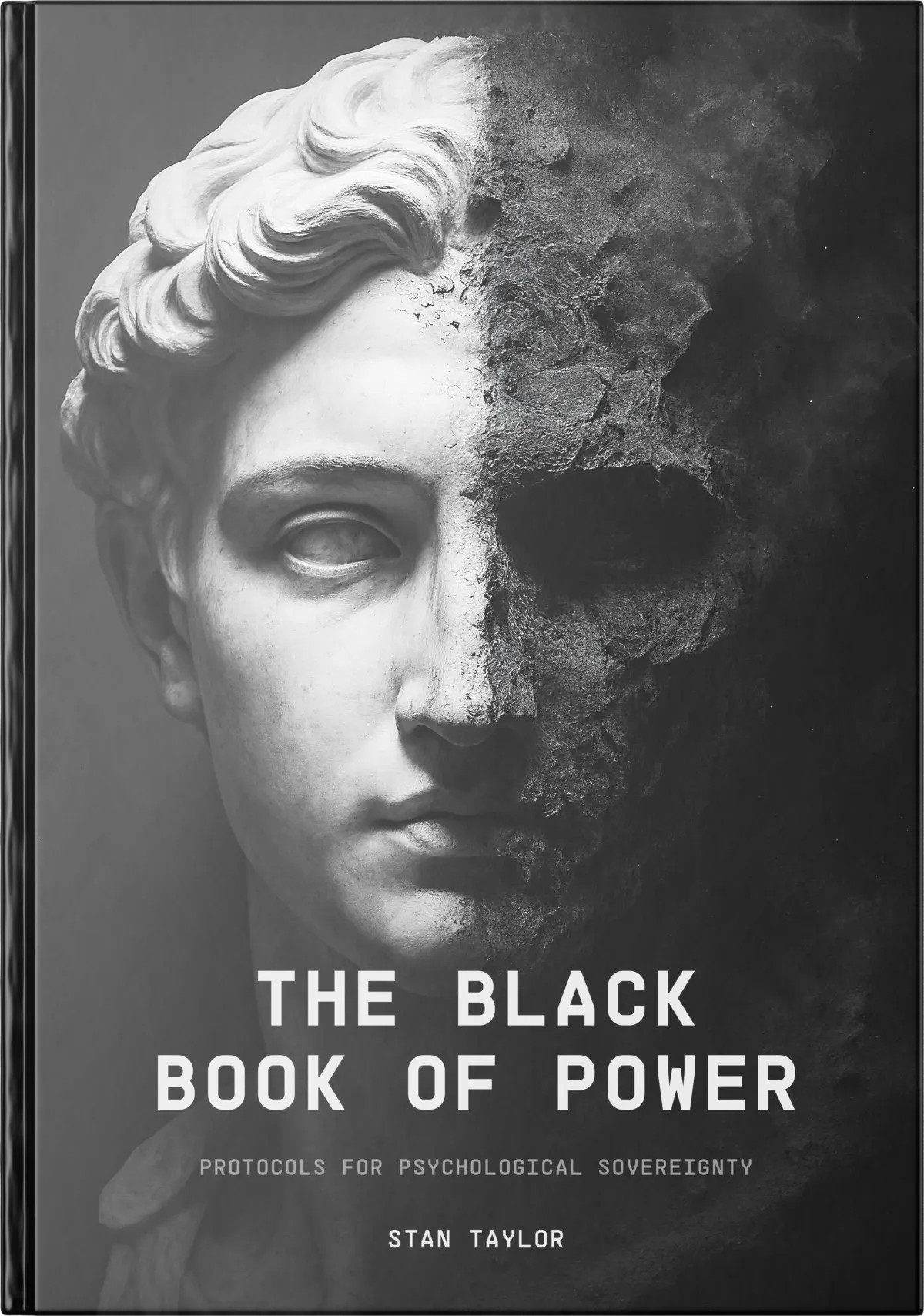
The Black Book of Power
Protocols for Psychological Sovereignty
The Black Book of Power
Hardcover Bundle $197
FREE PHYSICAL JOURNAL INCLUDED
Limited Edition with 650+ pages and full digital access.
For those who understand that some knowledge deserves physical form. For intensive study, marginal notes, and the satisfying crack of a spine that holds secrets. The book they'll find after you're gone and wonder who you really were.
Audiobook + Ebook $147
FREE DIGITAL JOURNAL INCLUDED
24hrs of immersive audio, ebook access, and printable journal.
Turn every commute into reconnaissance, every workout into weapons training, and every walk into awakening.
Ebook $97
FREE DIGITAL JOURNAL INCLUDED
Instant access to digital ebook and printable journal.
Perfect for those who need the intelligence NOW. Start your resurrection immediately after purchase. Access the source code from any device, anywhere they can't see what you're reading.
Five Stars Only
Readers on the Ethics of Influence
Five-star reviews by verified buyers on stantaylor.com, quoted as written.
Plain Answers
Questions About What It Means
What Does Dark Psychology Mean?
It is the popular name for the study and use of manipulation, deception and exploitation. Psychologists research the related personality traits under the name dark triad, and none of the sources the editors read describes a field called dark psychology.
Is Dark Psychology Evil?
The moves take their character from their use, and The Black Book of Power by Stan Taylor says how to tell: the Three-Gate Test of Chapter 19 asks about truth, dignity and genuine need, which settles what is dark psychology, mean or not, one move at a time.
Is It Wrong to Learn Dark Psychology?
Seeing a tactic is the first defense the book teaches against it, and Chapter 2 puts the point plainly: "You can see the manipulation without being manipulated." Using a tactic is a separate decision, and Part V of the book treats it at length.
What Is Dark in Psychology?
In the research literature, dark refers to the dark triad and the dark tetrad: narcissism, Machiavellianism, psychopathy and, in the tetrad, sadism. Wikipedia's article describes the triad's traits as aversive but non-pathological, which places them among unpleasant ways of being and short of a diagnosis.
Pass the Three Gates
Learn the Moves and the Standard
The book teaches the tactics and the test for refusing them, with three weeks of practice in your own conversations before either.
Get the Book$197 Read the Definition
- Free Journal Included With Every Edition
- Join a Private Community of Readers
- 90-Day Money Back Guarantee